Frequently asked questions
For a comprehensive breakdown tailored to your business, please contact our sales team for personalized assistance.
Contact SalesGeneral
Overview of Truflation and how our inflation metrics compare to government and other private measures.
What is Truflation?
Truflation is the real-time truth layer for macro markets. We provide investors with actionable, high-frequency trading signals built on transparent, independently verified economic data. Instead of waiting 30–60 days for government releases, our users get daily insights across 200+ indexes — inflation, housing, consumer categories, and more — all derived from real market prices, cross-checked across multiple sources, and published on-chain for transparency. AI helps us process millions of data points so enterprises can access clean, audited, ready-to-use signals through our API.
How are Truflation inflation metrics different from government inflation metrics?
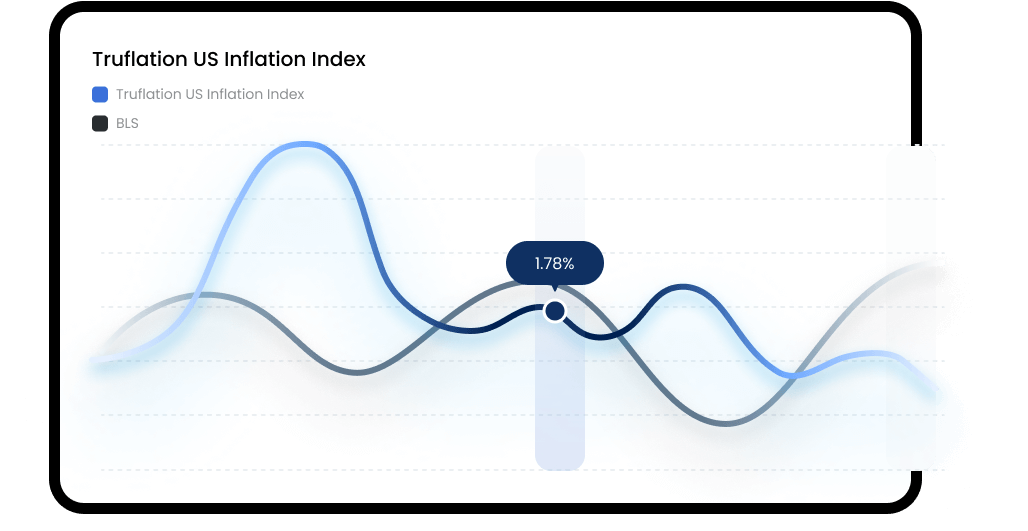
Enter into the realm of inflation measurements: the Bureau of Economic Analysis Personal Consumption Expenditures Price Index (PCE PI) and the Bureau of Labor Statistics Consumer Price Index (BLS CPI) have long held the spotlight, Truflation has emerged as an alternative real-time inflation index, promising a fresh perspective to truly understanding inflationary trends. All three metrics are designed to measure inflation and track the change in the prices of goods and services over time. The main differences between the PCE PI, the BLS CPI and Truflation are:
Update Frequency: PCE PI & BLS CPI are updated monthly, offering a snapshot of inflation trends over the past month. Truflation is updated daily, providing a real-time perspective on inflationary changes.
Data Points: The BLS CPI is based on roughly 80,000 data points, encompassing a selected basket of goods and services, while Truflation tracks over 15 million items, capturing a broader spectrum of the market and offering a more granular view.
Adjustment & Mechanisms: The PCE PI & BLS CPI incorporate mechanisms like substitutions (when consumers switch from a more expensive item to a cheaper one) and hedonic adjustments (which account for quality changes in goods and services). Given the comprehensive data coverage of Truflation, it doesn't need to rely on such mechanisms. Its broad scope inherently captures market shifts and quality variations.
Housing Costs: The PCE PI & BLS CPI consider housing-related prices as owners equivalent rent which is derived from the BLS CPI and estimates what homeowners would pay if they were renting their homes. Truflation’s CPI Index includes the cost of home purchases by factoring in mortgage payments (by calculating the monthly mortgage rate, volume of mortgages issued and the average price of housing), thus providing a more direct reflection of the housing market's impact on consumers' expenses.
Comparison between PCE PI vs CPI vs Truflation
PCE Price Index | BLS CPI | Truflation (US CPI) | |
|---|---|---|---|
Publication | Bureau of Economic Analysis (BEA) | Bureau of Labor Statistics (BLS) | Tru Labs Inc. |
Data Source | Census Bureau’s Monthly Retail Trade Report & Housing Survey | Point-of-Purchase Price Check & Housing Survey | Market price data from 30+ data sources |
# of Data Points | Data not available | 80,000 items | 15+ million items |
Publish Frequency | Monthly | Monthly | Daily |
Markets/Indexes | Headline, Goods, Services & Core and categories | Headline, Goods, Services & Core and categories | Headline, Goods, Services & Core and categories |
Weighting | Flexible | Fixed | Flexible |
Substitution | Yes; Chain-type | Hedonistic adjustments | No |
Calculation | (PCE PI in the current period - PCE PI in the previous period) / PCE PI in the previous period x 100% | (BLS CPI in the current period - BLS CPI in the previous period) / BLS CPI in the previous period] x 100% | (Truflation in the current period - Truflation in the previous period) / Truflation in the previous period] x 100% |
Exclusions | Purchases of homes | Prices of investments, property taxes and purchases of homes | No exclusions |
Main Users | Federal Reserve, Economists & Analysts | Federal Reserve, Government, Businesses, Economists & Analysts | Retail Users, Economists & Analysts |
Why should I trust Truflation’s Inflation metrics?
Truflation uses:
Deep Data: We track more than 15+ million items from over 30+ data sources in the US. Each data point that we release within the Inflation Index has a minimum of 3 different data sources to enhance accuracy.
Granular Categories: We have an extensive and continually growing list of categories and sub-categories available that lend different market insights.
Updated Daily: Truflation’s tracking of goods and services is updated daily.
Faster: Truflation is a leading indicator of the government indexes by an average of 45 days.
Truflation data has been validated by a number of institutions and economists including the Pennsylvania State University, Stockholm Economic University etc.
How is Truflation different from other private inflation measures?
There are a number of private organisations that measure inflation beyond Truflation, like Price Stats or Adobe Digital Prices which reflects a broader shift in economics, away from relying solely on official monthly / quarterly data towards “big data, real time” economics They provide an early warning of inflation surges or deflation, which is useful in volatile times.
For central banks or policymakers, these alternative indices are helpful as complements and eventually as replacements to traditional measures. For businesses, investors, or households, these indices help anticipate where price pressure is building (or receding) sooner than official data, enabling proactive decisions (e.g. hedging, pricing adjustments, inflation-linked strategies).
The key differences between Truflation, Price Stats and Adobe Digital prices are:
Truflation | PriceStats | Adobe Digital Price Index | |
|---|---|---|---|
Data frequency / latency | Daily (real-time) updates. | Daily price scraping; indices published with small lag (e.g. 3-day lag) | Monthly (data aggregated from daily retail, but reported monthly) using product matches. |
Scope (basket) | Broad consumption basket of market price data from 30+ data sources in the US with more than 15M items of goods and services that includes housing. | Consumer goods (retail products) sold by participating retailers which are primarily retail goods, not necessarily entire services or housing. | Online retail goods across 18 categories with offline purchases, services and many non retail goods excluded. |
Weighting / aggregation method | Uses weights that reflect the broader consumption patterns and is updated annually. | Uses BLS CPI style weights where possible; calculates price changes using matched goods with no quality adjustments). | Uses Fisher price index, matched products, weighted by actual quantities purchased month to month. |
Type of prices tracked | Broad consumption of goods (new and used), housing (owned and rented) and services. | Retail goods sold by selected retailers (mainly physical and online retail) — generally excludes services, housing, | Online retail goods only; excludes offline purchases, many services, and non-retail consumption. |
The strategic benefits of each of the three services:
Truflation: Provides you with the most comprehensive, real time look at inflation or cost of living. This is because of its daily updates and its broad basket coverage, Truflation is above to capture inflationary pressures that standard indexes miss, especially in volatile environments.
Price Stats: Provides you with high frequency monitoring of retail inflation trends, because of its daily scraping of large amounts of retail-price data. PriceStats observes inflation shifts almost in real time, Given PriceStats largely reflects retail goods sold by a subset of (mostly large) retailers, it may underrepresent services, housing, small/local shops, and non-retail consumption, which are all important parts of a typical consumer basket.
Adobe DPI: Its a comprehensive understanding of online retail prices. It is useful for tracking deflation or inflation in the online retail space - often a leading indicator for broader retail price trends but only captures online retail goods and excludes offline purchases, many services, housing, and non-retail consumption. So it can’t serve as a full “cost-of-living” or macro inflation index on its own.
How does Truflation determine the category weighting?
Each category's relative importance is achieved by taking multiple sources and triangulating the impact. These data sources include the Truflation Personal Inflation Calculator, Credit Card transaction data, Government Census / Mini Census (where available), household establishment expenditure surveys from NielsenIQ, Kantar and Global Demographics combined with Government Statistics Departments e.g. Bureau of Labor Statistics. These data sources are then validated against Truflation's data providers and other third-party sources (e.g. government retail sales data, mortgage spending etc.) Combining these data sources and aligning the different methodologies allows Truflation to produce more comprehensive unbiased data. The relative importance is updated annually and implemented in February of each year using the previous year’s data to reflect the changing consumer expenditure behaviors.
Where would I find Truflations Legal T&C's ?
All Truflation legal documentation — including the Terms of Service, Privacy Policy, regulatory information, and guidance on reporting compliance concerns — is centrally available within the Legal Information Help Center.
Data Collection
How we gather, verify, and process economic data from multiple sources.
When is the data collected?
New data from each available source is gathered daily at 11:00 PM Coordinated Universal Time (UTC). All the collected historical pricing data points are loaded directly into our source database. Each provider's data is then added into a separate database table.
Every time new data is ingested and collected, necessary quality control procedures are undertaken daily to ensure the accuracy and representation of the data sources. Once this is complete then the data is updated in the system.
It undergoes a 24-hour hold period and is then locked until 23:59 UTC the next day. For example, data that is collected at 23:00 UTC on the 4th of the month will be published at 23:59 UTC on the 5th.
How is the ingested data verified?
For every data partner that is ingested into Truflation, an audit process is conducted that includes: documentation of the methodology, determining the representation of the data, understanding the quality control procedures the data partners undertake, and of course, administrative & legal document sign-off - which is necessary to ensure Truflation has the legal representation to repurpose the data and add it to other data sources to create the index.
Thereafter, every day Truflation undertakes a quality control process on every data set that includes the following 4 steps:
Historical data comparison
Most recent data presence
Current data comparison
Data variation assessment
How are each of the data indexes built?
Truflation leverages at a minimum three data sources for every index that is released and each data set for that index is weighted according to:
1. The geographical representation
2. The type of methodology used to collect the data and
3. The volume of data
Each of the weighting elements (1 x 2 x 3) for the data partner are then multiplied to determine the overall aggregated weighting factor for this data partner. Then this is compared to the other data providers in that category and is assigned a weighting factor of the new data vs existing data partners.
How much historical data do you have?
Truflation’s historical data for each market varies, with the US Inflation Index representing the longest history, going back to January 1, 2010.
What is the difference between Frozen and unfrozen data?
Truflation has two different types of data; Frozen and Unfrozen Data. The difference between the two data sets are:
Frozen Data: Data that is fixed, immutable, and does not change. Once “frozen,” it will not be updated, overwritten, or altered. Used for consistency, reproducibility, audits, or stable baselines.
Unfrozen Data: Data that is updated and subject to change. New entries can be added, values can change, and the dataset evolves over time.
Data on our dashboard are all Frozen but our subscribing customers have the option to access both Frozen and Unfrozen data through the member dashboard.
How does Truflation measure Rental prices?
Generally renewals tend to be stickier, smoother and gradual increases due to lease terms and landlord-tenant relationships while new rentals tend to be more volatile, respond to real-time conditions, stronger peaks and troughs. Truflation is tracking both and allows analysts to understand the stability and market volatility providing a complete picture of the rental inflation market.
To provide an example of this in 2021 and 2022 new lease rents surged >15% in many cities, but renewal rents were rising only 4–6%. The official housing inflation by the BLS didn’t spike until many months later. Measuring both revealed immediate pressure of new rentals and the actual household impact of renewals giving us a comprehensive view of the expected future BLS CPI changes (lagged renewal increases).
Why does the Truflation Index often move on the 1st of the month?
Truflation measures inflation as a year on year price percentage change of the basket of goods and services. Truflation tracks the price changes in real time, pulling from millions of price points across dozens of categories and subcategories.
The prices of goods and services from each of the different data providers, are updated on different schedules, eg daily, weekly and monthly. The monthly updates which include housing (rent, utilities), insurance, residential communications, education fees, etc get updated on the 1st of every month. Given that these categories represent over 50% of household expenditures, when these categories shift then the overall index adjusts accordingly.
These shifts on the 1st of every month can cause visible spikes. But it’s also the cleanest, most transparent way to show how inflation trends naturally form including the volatility. Our users rely on Truflation to spot turning points in real time not months later.
Data Delivery
How you receive data via the Member Dashboard, API, or FTP.
How is the data delivered?
The delivery of the data depends on the subscription model of the client, but there are three types of delivery: through the Truflation Member Dashboard, API or via FTP’s . For more details please visit our pricing page.
What is the frequency of the data?
The Truflation data is updated daily across all of our markets.
What data is included in the CSV files as part of the subscription?
There are five sets of data in the files delivered and access to each of the data sets depends on the subscription tier.
Truflation: Data includes headline, goods, services, core and associated Truflation categories and sub categories.
Truflation BLS Data: This is Truflation data mapped and aligned to the BLS CPI categorisation and associated weighting. This data includes headline, energy, food, Core, Core goods categories and core services categories.
BLS CPI Data: This is the BLS CPI data as published by the BLS.
Truflation BEA PCE Data: This is Truflation data mapped and aligned to the BEA PCE PI categorisation and associated weighting. This data includes headline, goods, services, core and associated categories.
BEA PCI Data: This is the BEA PCE PI data as published by the BEA.
For each index that is published there are three data points:
The Index number published today
The Index number published a year ago today
The Year on Year Inflation rate
The exact details of each of the content of the data sets are available through the download dashboard.
Does Truflation have a Data License Agreement?
Truflation's data license agreement can be found at: https://truflation.com/data-license/
Subscription
Plans, billing, and account management.
Can I upgrade or downgrade my plan at any time?
Yes, you can easily upgrade or downgrade your plan at any time to accommodate your changing business needs. Billing is done on a monthly or annual basis, depending on the subscription plan you choose. Details of the billing cycle will be provided during the sign-up process. Simply log in and change your plan and the adjustment will be made to your next billing cycle.
Can I cancel my subscription at any time, if so, what happens to my data?
Yes, you can cancel your subscription at any time. Upon cancellation, your data will remain accessible for a specified period, after which it will be securely deleted according to our data retention policy.
Are there any additional fees or hidden charges associated with the pricing plan?
No, there are no hidden charges. All fees and charges are clearly outlined in our pricing plans. Any additional services or features will be explicitly mentioned and charged accordingly.
Is there a free trial available?
Yes, we offer a free trial for new users to explore our services and see how they fit their needs. The duration and features available during the free trial are specified on our pricing page.
What payment methods do you accept?
We accept various payment methods including credit/debit cards and PayPal. Specific payment options will be detailed during the checkout process.
Is there a discount for annual subscriptions?
Yes, we offer a 20% discount for annual subscriptions compared to monthly payments. The discount percentage and total savings will be shown when you select an annual plan.
Can I switch from a monthly plan to an annual plan?
Yes, you can switch from a monthly plan to an annual plan at any time. The switch will take effect at the end of your current billing cycle, and the annual billing will commence from the next cycle.
How do I access support if I have issues with my plan?
All our plans include access to customer support. You can contact our support team through email support@truflation.com.
How do I manage my subscription and account settings?
You can manage your subscription and account settings through your account dashboard. This includes updating payment information, changing plans, and accessing billing history.
Do you offer custom plans for enterprises or large organizations?
Yes, we offer custom plans tailored to the needs of enterprises and large organizations. Please contact our sales team at info@truflation.com for more information and to discuss your specific requirements.
What happens if there are changes to the pricing plan?
If there are any changes to our pricing plans, we will notify existing customers in advance. Any changes will typically apply to new subscriptions, and existing customers may continue with their current plan or choose to upgrade or downgrade based on the new pricing structure.
Security
How we protect your data and systems.
What is Truflation’s security protocol?
At Truflation, we prioritize data security to protect the integrity and confidentiality of the information provided by our data partners. Our security measures include:
Role-based access control (RBAC) to ensure only necessary personnel can access sensitive data.
Access to raw data is restricted to authorized personnel only based on the principle of least privilege.
Multi-factor authentication (MFA) is enforced for all system access.
API access is secured using OAuth 2.0, API keys, or token-based authentication.
What measures does Truflation take to protect against external threats?
Our systems are hosted on secure cloud environments (AWS) with DDoS protection and firewall security.
How does Truflation monitor and log access to ensure system security?
Continuous monitoring and logging of data access and usage is crucial for data security. We use SIEM tools, aggregate logs and identify anomalies to detect security breaches, enabling Truflation to proactively protect the data.
What policies does Truflation have for secure data handling and retention?
We uphold principles of data transparency and retain information exclusively for the purposes consented to, adhering to stringent policies that govern both the management of data throughout its lifecycle and its eventual deletion.
Developers
Integrate reliable, transparent data into your applications.

Subscribe to our data
Unlock comprehensive inflation datasets tailored to your needs and stay ahead with data-driven decisions.
Go to pricing'%3e%3cg%20filter='url(%23filter1_d_3842_30305)'%3e%3cpath%20d='M20%2012.6799C20%2010.4836%2021.7909%208.70312%2024%208.70312H96C98.209%208.70312%20100%2010.4836%20100%2012.6799V68.3543C100%2070.5505%2098.209%2072.331%2096%2072.331H24C21.7909%2072.331%2020%2070.5505%2020%2068.3543V12.6799Z'%20fill='url(%23paint0_linear_3842_30305)'/%3e%3c/g%3e%3cpath%20d='M4%2038.4087C4%2035.8992%206.3093%2034.0171%208.7845%2034.5092L42.3922%2041.1918C43.3271%2041.3776%2044%2042.1937%2044%2043.1414V102.713C44%20103.968%2042.8454%20104.91%2041.6078%20104.664L7.2155%2097.8251C5.3458%2097.4532%204%2095.8218%204%2093.9257V38.4087Z'%20fill='white'%20fill-opacity='0.5'/%3e%3cpath%20d='M44%2043.1414C44%2042.1937%2044.6729%2041.3776%2045.6078%2041.1918L79.2155%2034.5092C81.6907%2034.0171%2084%2035.8992%2084%2038.4087V93.9257C84%2095.8218%2082.6542%2097.4532%2080.7845%2097.8251L46.3922%20104.664C45.1547%20104.91%2044%20103.968%2044%20102.713V43.1414Z'%20fill='white'%20fill-opacity='0.5'/%3e%3cpath%20d='M12%2032.4501C12%2031.0618%2013.3947%2030.1009%2014.7022%2030.5884L41.4045%2040.5434C42.9657%2041.1255%2044%2042.6093%2044%2044.267V99.4005C44%20102.177%2041.2105%20104.099%2038.5955%20103.124L13.2978%2093.6926C12.5171%2093.4016%2012%2092.6597%2012%2091.8308V32.4501Z'%20fill='white'%20fill-opacity='0.6'/%3e%3cpath%20d='M44%2044.267C44%2042.6093%2045.0343%2041.1255%2046.5955%2040.5434L73.2978%2030.5884C74.6053%2030.1009%2076%2031.0618%2076%2032.4501V91.8308C76%2092.6597%2075.4829%2093.4016%2074.7022%2093.6926L49.4045%20103.124C46.7895%20104.099%2044%20102.177%2044%2099.4005V44.267Z'%20fill='white'%20fill-opacity='0.6'/%3e%3c/g%3e%3cdefs%3e%3cfilter%20id='filter0_d_3842_30305'%20x='0'%20y='4.70312'%20width='112'%20height='112'%20filterUnits='userSpaceOnUse'%20color-interpolation-filters='sRGB'%3e%3cfeFlood%20flood-opacity='0'%20result='BackgroundImageFix'/%3e%3cfeColorMatrix%20in='SourceAlpha'%20type='matrix'%20values='0%200%200%200%200%200%200%200%200%200%200%200%200%200%200%200%200%200%20127%200'%20result='hardAlpha'/%3e%3cfeOffset%20dx='4'%20dy='4'/%3e%3cfeGaussianBlur%20stdDeviation='4'/%3e%3cfeColorMatrix%20type='matrix'%20values='0%200%200%200%200.772632%200%200%200%200%200.772632%200%200%200%200%200.987368%200%200%200%200.3%200'/%3e%3cfeBlend%20mode='normal'%20in2='BackgroundImageFix'%20result='effect1_dropShadow_3842_30305'/%3e%3cfeBlend%20mode='normal'%20in='SourceGraphic'%20in2='effect1_dropShadow_3842_30305'%20result='shape'/%3e%3c/filter%3e%3cfilter%20id='filter1_d_3842_30305'%20x='12'%20y='0.703125'%20width='96'%20height='79.6279'%20filterUnits='userSpaceOnUse'%20color-interpolation-filters='sRGB'%3e%3cfeFlood%20flood-opacity='0'%20result='BackgroundImageFix'/%3e%3cfeColorMatrix%20in='SourceAlpha'%20type='matrix'%20values='0%200%200%200%200%200%200%200%200%200%200%200%200%200%200%200%200%200%20127%200'%20result='hardAlpha'/%3e%3cfeOffset/%3e%3cfeGaussianBlur%20stdDeviation='4'/%3e%3cfeComposite%20in2='hardAlpha'%20operator='out'/%3e%3cfeColorMatrix%20type='matrix'%20values='0%200%200%200%201%200%200%200%200%201%200%200%200%200%201%200%200%200%200.8%200'/%3e%3cfeBlend%20mode='normal'%20in2='BackgroundImageFix'%20result='effect1_dropShadow_3842_30305'/%3e%3cfeBlend%20mode='normal'%20in='SourceGraphic'%20in2='effect1_dropShadow_3842_30305'%20result='shape'/%3e%3c/filter%3e%3clinearGradient%20id='paint0_linear_3842_30305'%20x1='60'%20y1='8.70312'%20x2='60'%20y2='72.331'%20gradientUnits='userSpaceOnUse'%3e%3cstop%20stop-color='%236366F1'/%3e%3cstop%20offset='1'%20stop-color='%239EA6FF'/%3e%3c/linearGradient%3e%3c/defs%3e%3c/svg%3e)
API documentation
Access real-time inflation data and insights directly in your applications with our robust, developer-friendly API.
Get Started'%3e%3cg%20filter='url(%23filter1_d_3842_30326)'%3e%3cpath%20d='M100%2048.7031C100%2070.7945%2082.0914%2088.7031%2060%2088.7031C37.9086%2088.7031%2020%2070.7945%2020%2048.7031C20%2026.6117%2037.9086%208.70312%2060%208.70312C82.0914%208.70312%20100%2026.6117%20100%2048.7031Z'%20fill='url(%23paint0_linear_3842_30326)'/%3e%3cpath%20d='M100%2048.7031C100%2070.7945%2082.0914%2088.7031%2060%2088.7031C37.9086%2088.7031%2020%2070.7945%2020%2048.7031C20%2026.6117%2037.9086%208.70312%2060%208.70312C82.0914%208.70312%20100%2026.6117%20100%2048.7031Z'%20fill='url(%23paint1_linear_3842_30326)'/%3e%3c/g%3e%3cg%20filter='url(%23filter2_d_3842_30326)'%3e%3cpath%20fill-rule='evenodd'%20clip-rule='evenodd'%20d='M44%20104.703C66.0914%20104.703%2084%2086.7945%2084%2064.7031C84%2042.6117%2066.0914%2024.7031%2044%2024.7031C21.9086%2024.7031%204%2042.6117%204%2064.7031C4%2086.7945%2021.9086%20104.703%2044%20104.703Z'%20fill='white'%20fill-opacity='0.4'/%3e%3cpath%20d='M47.8287%2086.7031H38.4479V75.9998C38.4479%2064.7846%2047.5721%2055.661%2058.7866%2055.661H62.5232V65.0419H58.7866C52.7445%2065.0419%2047.8287%2069.9577%2047.8287%2075.9998V86.7031Z'%20fill='white'%20fill-opacity='0.3'/%3e%3cpath%20d='M29.2678%2065.0419H25.5312V55.661H29.2678C35.3099%2055.661%2040.2258%2050.7452%2040.2258%2044.7031H49.6066C49.6066%2055.9183%2040.4824%2065.0419%2029.2678%2065.0419Z'%20fill='white'%20fill-opacity='0.3'/%3e%3c/g%3e%3c/g%3e%3cdefs%3e%3cfilter%20id='filter0_d_3842_30326'%20x='0'%20y='4.70312'%20width='112'%20height='112'%20filterUnits='userSpaceOnUse'%20color-interpolation-filters='sRGB'%3e%3cfeFlood%20flood-opacity='0'%20result='BackgroundImageFix'/%3e%3cfeColorMatrix%20in='SourceAlpha'%20type='matrix'%20values='0%200%200%200%200%200%200%200%200%200%200%200%200%200%200%200%200%200%20127%200'%20result='hardAlpha'/%3e%3cfeOffset%20dx='4'%20dy='4'/%3e%3cfeGaussianBlur%20stdDeviation='4'/%3e%3cfeColorMatrix%20type='matrix'%20values='0%200%200%200%200.68%200%200%200%200%200.809261%200%200%200%200%201%200%200%200%200.7%200'/%3e%3cfeBlend%20mode='normal'%20in2='BackgroundImageFix'%20result='effect1_dropShadow_3842_30326'/%3e%3cfeBlend%20mode='normal'%20in='SourceGraphic'%20in2='effect1_dropShadow_3842_30326'%20result='shape'/%3e%3c/filter%3e%3cfilter%20id='filter1_d_3842_30326'%20x='12'%20y='0.703125'%20width='96'%20height='96'%20filterUnits='userSpaceOnUse'%20color-interpolation-filters='sRGB'%3e%3cfeFlood%20flood-opacity='0'%20result='BackgroundImageFix'/%3e%3cfeColorMatrix%20in='SourceAlpha'%20type='matrix'%20values='0%200%200%200%200%200%200%200%200%200%200%200%200%200%200%200%200%200%20127%200'%20result='hardAlpha'/%3e%3cfeOffset/%3e%3cfeGaussianBlur%20stdDeviation='4'/%3e%3cfeComposite%20in2='hardAlpha'%20operator='out'/%3e%3cfeColorMatrix%20type='matrix'%20values='0%200%200%200%201%200%200%200%200%201%200%200%200%200%201%200%200%200%200.8%200'/%3e%3cfeBlend%20mode='normal'%20in2='BackgroundImageFix'%20result='effect1_dropShadow_3842_30326'/%3e%3cfeBlend%20mode='normal'%20in='SourceGraphic'%20in2='effect1_dropShadow_3842_30326'%20result='shape'/%3e%3c/filter%3e%3cfilter%20id='filter2_d_3842_30326'%20x='-16'%20y='4.70312'%20width='120'%20height='120'%20filterUnits='userSpaceOnUse'%20color-interpolation-filters='sRGB'%3e%3cfeFlood%20flood-opacity='0'%20result='BackgroundImageFix'/%3e%3cfeColorMatrix%20in='SourceAlpha'%20type='matrix'%20values='0%200%200%200%200%200%200%200%200%200%200%200%200%200%200%200%200%200%20127%200'%20result='hardAlpha'/%3e%3cfeOffset/%3e%3cfeGaussianBlur%20stdDeviation='2'/%3e%3cfeComposite%20in2='hardAlpha'%20operator='out'/%3e%3cfeColorMatrix%20type='matrix'%20values='0%200%200%200%201%200%200%200%200%201%200%200%200%200%201%200%200%200%201%200'/%3e%3cfeBlend%20mode='normal'%20in2='BackgroundImageFix'%20result='effect1_dropShadow_3842_30326'/%3e%3cfeBlend%20mode='normal'%20in='SourceGraphic'%20in2='effect1_dropShadow_3842_30326'%20result='shape'/%3e%3c/filter%3e%3clinearGradient%20id='paint0_linear_3842_30326'%20x1='60'%20y1='8.70312'%20x2='60'%20y2='88.7031'%20gradientUnits='userSpaceOnUse'%3e%3cstop%20stop-color='%2321EB66'/%3e%3cstop%20offset='1'%20stop-color='%2312D583'/%3e%3c/linearGradient%3e%3clinearGradient%20id='paint1_linear_3842_30326'%20x1='60'%20y1='8.70312'%20x2='60'%20y2='88.7031'%20gradientUnits='userSpaceOnUse'%3e%3cstop%20stop-color='%236EA8FF'/%3e%3cstop%20offset='1'%20stop-color='%233B70DA'/%3e%3c/linearGradient%3e%3c/defs%3e%3c/svg%3e)
TRUF Network
Discover how decentralized technology powers real-time, transparent, and unbiased inflation data.
Learn more at TRUF.network