
Supply Shocks Drive Inflation, but Second Round Risks Are Growing
September's PCE release will be an important indicator of the direction of U.S. inflation, as the outlook continues to be shaped by energy volatility, tariff pass through and services inflation. Truflation's real-time indicators suggest that the latest acceleration remains concentrated in supply side pressures rather than reflecting a broad based resurgence in consumer demand. However, the growing transmission of higher input costs into producer prices and services raises the risk that inflation could become more persistent.
With the Federal Reserve's October policy meeting taking place before the scheduled October 29 BEA PCE release, the September figures will be particularly relevant to the December policy decision, alongside subsequent inflation and employment data.
The central question is whether higher energy prices, tariffs and rising production costs remain concentrated in selected categories or begin generating sustained inflation across the wider economy. This distinction is critical for monetary policy. Higher interest rates can restrain demand and limit second round inflation, but they cannot directly resolve energy supply disruptions or tariff pass through. The Fed must therefore balance the risk of entrenched inflation against the possibility that further tightening could aggravate weakness in employment and consumption.
1 | Where is PCE inflation heading?
The near-term inflation outlook remains dominated by elevated energy prices and the gradual pass-through of tariffs into consumer goods. Headline inflation is likely to remain volatile over the coming months, with its direction heavily dependent on developments in global energy markets and the extent to which higher input costs reach consumers.
Crude oil prices remained elevated throughout September, with WTI trading between approximately $92 and $103 per barrel, significantly above August levels. The impact is particularly evident in Truflation's gasoline and other energy goods category, which increased 6.0% MoM and 33.7% YoY.
The latest BEA PCE data for August showed headline inflation at 3.4% YoY and Core at 3.0% YoY. Truflation forecasts that September's official headline PCE will increase to 3.6% YoY, with Core reaching 3.1% YoY. Monthly increases are projected at 0.4% for headline and approximately 0.3% for Core, suggesting that underlying inflationary pressures may be extending beyond energy alone.
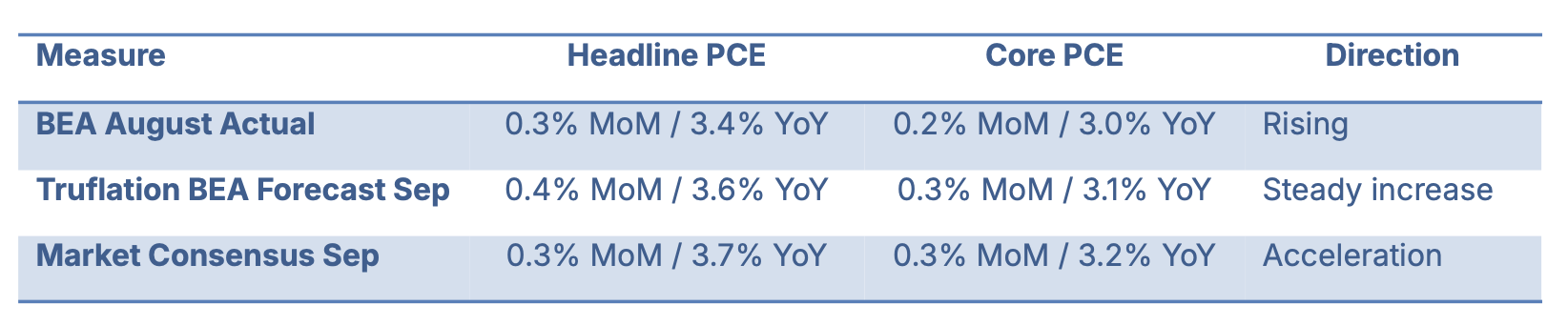
The forecast suggests that headline inflation may accelerate further, with a more modest increase in Core. However, the key question is whether this signals a genuine broadening of inflation or primarily reflects the indirect transmission of higher energy and tariff costs.
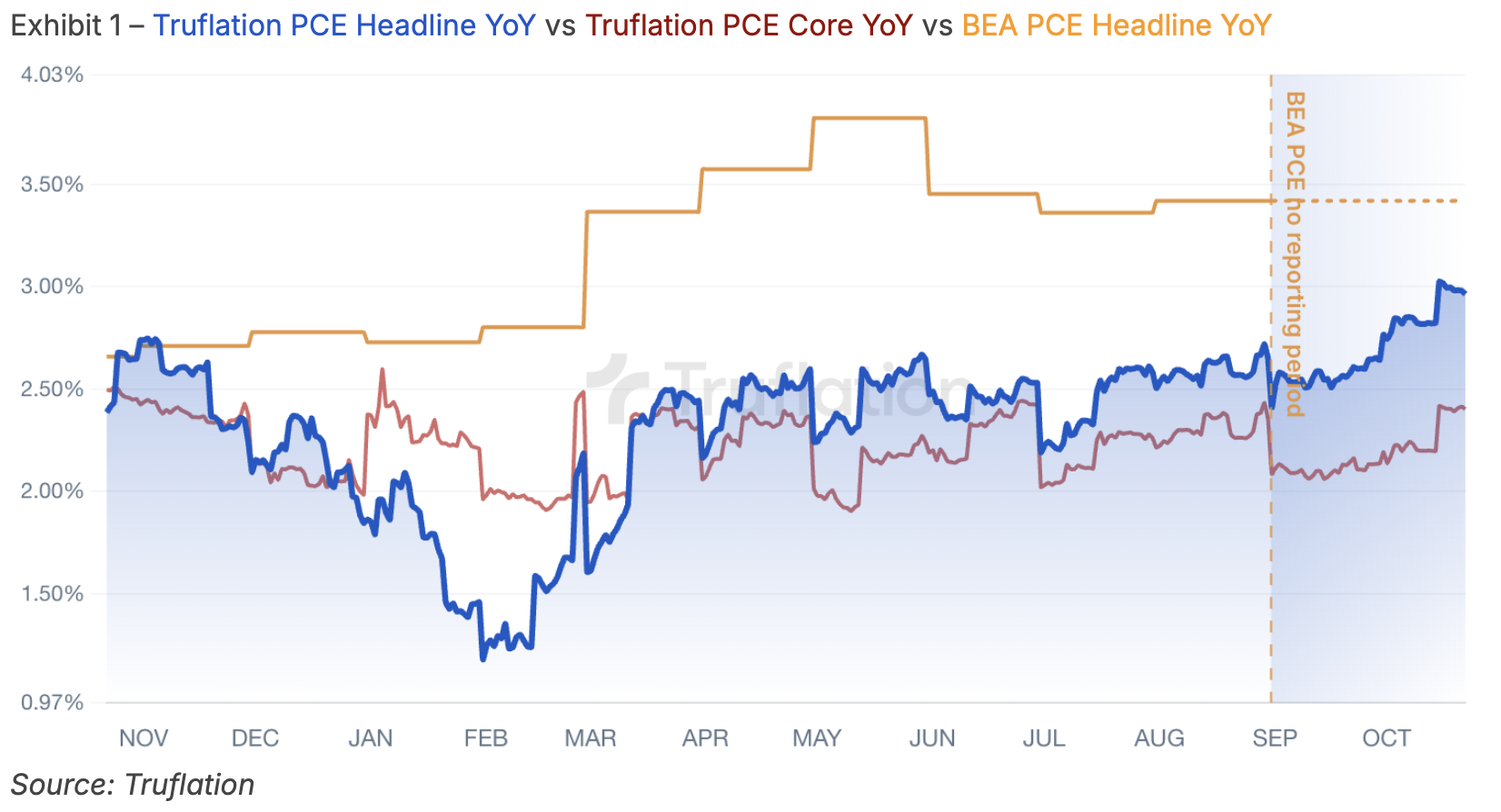
Truflation's own September TruPCE measures provide a complementary signal, with headline inflation at +0.24% MoM and +2.80% YoY, compared with Core at +0.24% MoM and +2.40% YoY. The gap between headline and Core reinforces the significance of volatile components, while the relatively contained Core reading suggests that other categories continue to offset stronger increases in energy and selected goods.
Services: Services inflation remains persistent, particularly in labor intensive categories such as food services, accommodation and transportation. These industries remain exposed to elevated wages, energy costs and other operating expenses, although seasonal moderation in travel and leisure demand is beginning to limit pricing power.
Housing has provided an important disinflationary offset, but this contribution is weakening. New apartment supply and landlord concessions have helped contain effective rent growth, while affordability constraints continue to prevent prospective buyers from transitioning into homeownership. If rental construction slows and concessions normalize, rents could become a renewed source of inflationary pressure.
Goods: Goods are becoming a more significant inflation risk as tariffs increase the cost of newly arriving inventory. The disinflationary contribution from goods over recent years is becoming less reliable, with higher import costs increasingly visible in apparel, recreational goods and motor vehicles. However, discounting and weaker demand continue to provide some offset, particularly in household durables.
The central issue is increasingly the breadth of inflation rather than simply its level. Energy and tariff pressures remain concentrated in particular categories, but sustained pass-through into other goods and services would strengthen the case for more persistent underlying inflation and potentially further monetary tightening.
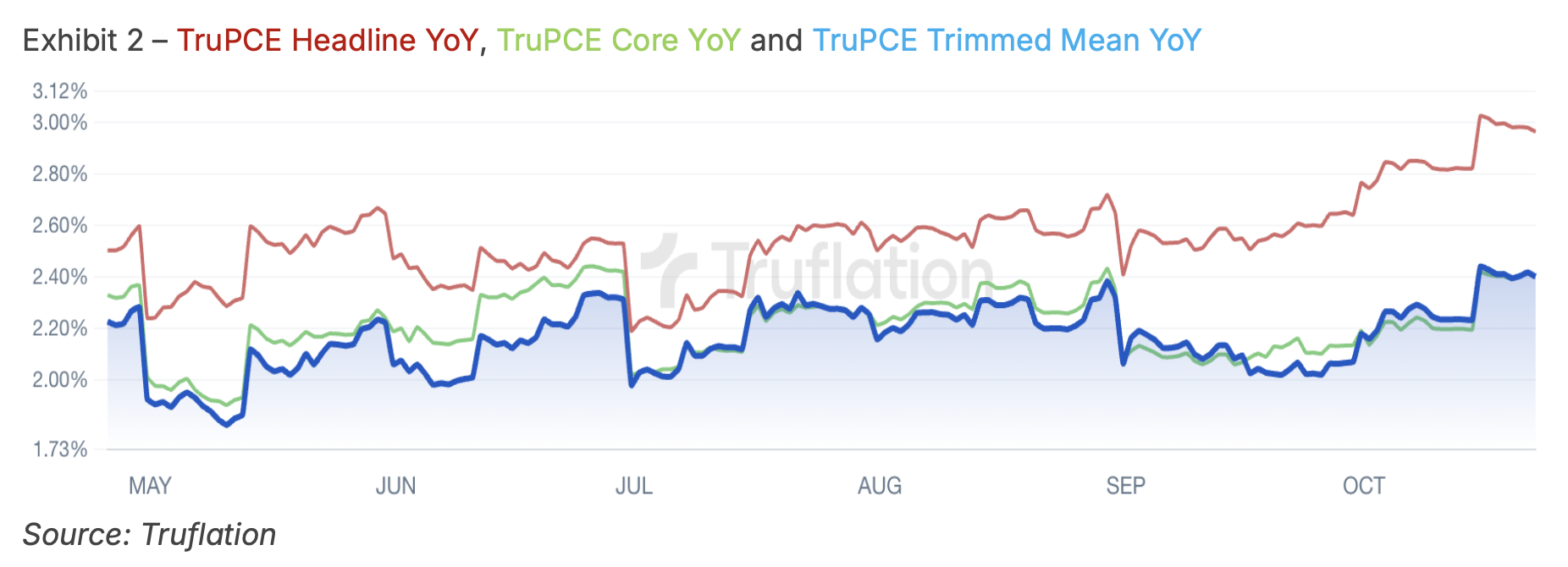
Truflation's base case remains for inflation to plateau through the remainder of 2026 before gradually moderating during 2027. However, the path is unlikely to be smooth, with energy prices, tariffs and potentially housing keeping both headline and Core PCE above the Federal Reserve's 2% target.
2 | What are the Movers & Shakers?
Gasoline & Other Energy Goods: +6.0% MoM | +33.7% YoY. Gasoline prices continued to surge in September, driven primarily by elevated crude oil prices amid supply disruptions linked to the conflict with Iran and restricted shipping through the Strait of Hormuz. Tighter refining capacity and declining inventories compounded these pressures, pushing the national average gasoline price up from approximately $4.14 per gallon in early September to $4.37 on October 23rd. While some moderation is possible if crude oil prices stabilize, continued disruptions are more likely and thus keep fuel prices elevated in the near term.
Clothing & Footwear: +2.21% MoM | +4.36% YoY. Apparel and footwear prices rose again in September as retailers transitioned from discounted summer and back to school merchandise to new fall collections that added further upward pressure, with seasonal inventory turnover allowing retailers to introduce higher priced products. Looking ahead, tariffs are likely to sustain underlying price pressures, although growing competition and selective discounting could moderate further increases during the holiday shopping season.
Motor Vehicles & Parts: +0.56% MoM | +1.01% YoY. Motor vehicle prices rose modestly in September, driven primarily by the arrival of higher priced new model inventory, pushing average new vehicle transaction prices to approximately $50,562, just below their all time high. However, wholesale used vehicle prices declined 1.1% MoM as elevated fuel costs, affordability constraints and seasonal depreciation weighed on demand. Consumers are increasingly shifting toward smaller, more affordable vehicles, while manufacturers and dealers are offering greater incentives to maintain sales volumes. New models pricing may sustain some upward pressure, but used vehicle and affordability concerns should help contain broader vehicle inflation.
Food & Beverages for Off Premise: -0.83% MoM | +1.15% YoY. Grocery prices declined in September, supported by increased promotional activity aimed at price sensitive consumers. Price reductions were particularly evident across selected fresh produce and meat products, with retailers including Aldi announcing further cuts to everyday staples. Continued discounting could provide additional relief, although elevated fuel and distribution costs may limit further reductions.
Household Furnishing & Durable Equipment: -0.54% MoM | +0.64% YoY. Prices declined in September, driven primarily by Labor Day promotions and end of summer inventory clearance across furniture, appliances and home furnishings. Major retailers, including Home Depot and Best Buy, offered substantial discounts on large appliances, while furniture retailers reduced prices to clear inventory and stimulate demand. Weaker housing market activity added further pressure to the reduced demand for major household purchases. Softer consumer demand is likely to keep prices contained, although tariffs and import costs may limit further declines.
Housing & Utilities: +0.12% MoM | +1.90% YoY. Housing and utility prices increased modestly in September, reflecting subdued homeownership activity as elevated mortgage rates continue to constrain housing transactions. Electricity infrastructure investment and energy costs maintain pressure on household utility bills..
- Owned: Homeownership affordability remained stretched in September, with elevated mortgage rates weighing on buyer demand. New home sales were 2.0% below a year with 8.5 months supply encouraging price reductions. Unless borrowing costs ease, housing activity is likely to remain subdued.
- Rentals: Rental demand continues to benefit from affordability constraints that keep prospective homebuyers in the rental market. Monthly rent growth remains modest at approximately 0.1%, as additional supply and landlord concessions, offered on nearly 40% of listings, limit pricing power. These forces will help to contain rental inflation in the near term, although slower construction and declining concessions present longer term risks.
- Short-Term lodging: Hotel prices strengthened during the latter half of September, supported by business travel, conferences and major events, with average daily room rates increasing in some regions by 7% YoY. Accommodation prices are likely to remain volatile as demand shifts into the fall travel season.
Taken together, the category level evidence suggests that the acceleration remains concentrated in energy and tariffs pass through into selected consumer goods rather than reflecting a broad based resurgence in demand. While hospitality and other services continue to benefit from resilient spending, declining prices across groceries and household durables demonstrate that consumer pricing power remains uneven.
3 | Demand Driven Versus Supply Driven Inflation?
September's TruPCE data points to a mixture of supply and demand side pressures, with adverse supply shocks remaining the dominant driver. Higher energy prices, tariff related imported costs are raising prices across selected goods, while resilient demand in dining and accommodation has enabled sectors to see increase in prices.
However, declining grocery prices, transportation services and household durables, alongside subdued housing inflation, suggest that price pressures are not yet broad based. September's seasonal moderation in travel demand also indicates that pricing power may be weakening in some service categories.
This distinction matters for monetary policy. Higher interest rates can restrain demand and limit the spread of inflation, but they cannot directly resolve energy shortages, increase capacity or reverse tariffs. The greater medium term risk is that concentrated cost increases become embedded in wages, rents and broader service prices.For now, September's evidence is more consistent with supply driven inflation supported by selective pockets of resilient demand, rather than generalized overheating across the economy.
4 | Other factors driving inflation
Beyond individual PCE categories, three broader economic forces are shaping the inflation outlook: tariffs, producer prices and the labor market. The latest October developments reinforce the role of supply side pressures while highlighting the growing risk of transmission into services.
Tariffs: Persistent Cost Pressures Despite Selective Trade Relief
Tariffs remain a source of inflationary pressure, although recent developments point to selective easing. In October, the administration announced exemptions for selected Canadian products, while the extension of the U.S. - China trade truce until January 2027 has reduced some near term price prices. However, existing duties remain elevated, continuing to place pressure on import costs.
While businesses have absorbed part of the increase in import expenses, higher costs are progressively being reflected in prices as inventories are replenished and supply contracts renewed. Despite selective tariff relief, the broader trade continues to exert upward pressure on consumer goods. As a result, tariffs remain a significant supply side inflation risk, particularly as businesses increasingly pass accumulated costs through to consumers.
Producer Prices: Energy Dominates, but Pressures are Spreading
Producer price increased 1.3% MoM in September, the largest monthly gain since March 2022,, providing further evidence that higher energy costs are moving through the supply chain. Goods prices rose 2.6%, driven overwhelmingly by energy, which increased 10.8%. More than 80% of the monthly rise in goods producer prices was attributable to energy, highlighting the supply driven nature of the initial shock.
However, the latest figures also point to growing second round pressures. Producer prices for services increased 0.8% MoM, while transportation and warehousing services rose 3.4%, consistent with the transmission of higher fuel costs into freight and distribution. Producer prices excluding food, energy and trade services increased 0.5%, compared with 0.3% in August, suggesting that underlying upstream pressures are also strengthening.
If these pressures persist, inflation could spread more widely into consumer goods and services even without a significant acceleration in underlying demand.
Labor and Wages: Resilience Without Strong Hiring
The labor market remains relatively resilient despite a prolonged period of weak hiring. Initial unemployment claims fell to 194,000 in the week ending October 17, approaching levels last seen in 1969 indicating that layoffs remain limited. September payroll employment increased by only 29,000, while unemployment was relatively steady at 4.2%. This points to a labor market characterized by low layoffs and limited hiring, rather than renewed strength in labor demand.
Wage developments remain important for the services inflation outlook. Truflation's measures of salaries, hourly wages and temporary worker income have been hovering around 4.0% - 4.5% YoY since mid-2025, suggesting continued compensation pressures for labor intensive businesses. If compensation continues to rise faster than productivity, businesses may maintain pressure on prices to protect margins. However, subdued hiring and growing consumer price sensitivity should constrain the scope for a broader demand-driven acceleration.
Overall, the latest evidence continues to favor a supply led interpretation of inflation, but with an increasing risk that higher energy and import costs spread into freight, distribution and consumer facing services. Sustained wages, rents and underlying services inflation would provide stronger evidence that price pressures are becoming more persistent.
5 | Federal Reserve Implications
The combination of elevated energy costs, higher tariffs and growing evidence of pass through is reducing the Federal Reserve's flexibility to lower interest rates. Following September's 25-basis point increase, which brought the federal funds target range to 3.75%-4.00%, policymakers face a difficult balance between containing inflation and avoiding unnecessary weakness in economic activity.
While much of the current acceleration remains supply driven, the transmission of higher import and energy costs into producer prices, transportation and other services increases the risk of more persistent inflation. Consequently, expectations have shifted toward maintaining restrictive rates, with economists increasingly anticipating another increase in December.
The challenge is that higher rates cannot directly reverse tariffs or resolve energy supply disruptions. Instead, monetary policy can restrain demand, reduce the scope for further price increases and help keep longer-term inflation expectations anchored.
However, maintaining restrictive borrowing costs also carries risks, particularly for housing. Elevated mortgage rates discourage home purchases and new construction, potentially tightening rental supply over the medium term. This could weaken housing's disinflationary contribution just as other services face renewed cost pressures.
The direction of monetary policy will therefore depend increasingly on whether tariff and energy related price increases remain concentrated or develop into persistent inflation. A sustained broadening of inflation would strengthen the case for further tightening, while evidence of contained second round effects and weakening demand would support a more cautious approach.
6 | Summary
September's TruPCE data suggests that inflation remains predominantly supply driven, with higher energy prices, tariffs and rising import costs accounting for much of the recent acceleration. Headline TruPCE inflation stands at 2.80% YoY, compared with Core at 2.40%, while declining grocery, transportation service and household durable goods prices indicate that pressures are not yet broad based. However, accelerating producer prices and persistent wage pressures increase the risk that higher costs spread into services.
For the Federal Reserve, this creates a difficult balance. Higher interest rates can contain demand and limit second round inflation but cannot directly resolve supply disruptions or tariff related costs. Prolonged restrictive rates also risk weakening housing construction and sustaining future rental pressures. The key question is whether these supply driven shocks remain concentrated or become embedded in wages, housing and services. Until that becomes clearer, the inflation outlook favors monetary-policy caution, with limited scope for near-term rate reductions.
About Truflation
Truflation provides independent, real-time inflation indexes using data from more than 30 partners and tracking over 15 million product prices across the United States. Updated daily, its TruCPI and TruPCE indexes provide timely, market based signals that complement official inflation measures and offer earlier insights into emerging price trends.
